Feeds:
Posts
Comments

Moments of Connection

Reading the following passage from this paper brought me back to the lobby of a hostel in Thessaloniki :

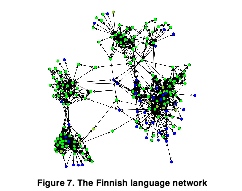
Figure 7

The Finnish network in Figure 7 is qualitatively different. It continues the trend observed in the Portuguese network in that it is smaller and looser, but unlike the previous networks, it lacks an apparent center. Rather, each seed journal and its friends constitutes an independent cluster. Moreover, rather than appearing mainly on the margins of the network, English appears in the centers of the clusters, and even in positions bi-directionally bridging between Finnish journals. This pattern is suggestive of a high degree of Finnish-English bilingualism among Finnish Live-Journalers; indeed, most of the English journals in this network appear to be written by Finns. Thus Finns have conversations on LJ in both Finnish and English, but mostly among themselves. [emphasis mine]

It was in that Thessaloniki hostel lobby that I came to a banal-but-then-amazing realization – while watching a Swedish gent chat up a Japanese lass, I consciously realized, perhaps for the first time, that every day there are probably somewhere in the dozens to hundreds of millions of people speaking to each other in English, for whom English is not a first language. And in the years since (that was in 2002), English has since become not only the default international lingua franca (ironically, mostly not in the Western Hemisphere, where Spanish is increasingly dominant as an international language due to its increased penetration Stateside) but basically the default language of business in the EU. Not due to British cultural imperialism, either – just because it’s easier.

Indeed, English instruction starts so early in most Northern European countries that it can hardly be said to be a non-native language. Especially or the Finns and the Swedes, their export-and-knowledge-based economies (Nokia based in Finland, Linux born in Sweden) demand fluency not just in multiple languages but specifically the international language – and language of the Western internet – English [the Sino-Nipponese-Korean corner of the Net is another story entirely].

I often think about what impacts this will have long-term on the English language – the many divergent strands of slang and local dialect that are emerging among non-native English speakers even as American, Canadian and British regionalisms and colloquialisms are drowned in the ongoing homogenization of our national cultures.

Will an international English-language culture emerge? Has it already – is in fact the (Western) Internet just that? Is the emergence of a more-or-less global language a consequence of transnational trade harmonization – an outfall of GATT, NAFTA, EU, etc. – or does it set the stage for them? Or am I just part of an informational elite that makes it seem like there’s increasing internationalization when for most people, there’s not, and English is just the latest in a series of lingua francas for the transnational global elite? I’m not rightly sure, about any of these things. But it’s something, ain’t it?

The Stories We Tell

In my ongoing studies of identity, a thread that comes up again and again is the importance of narrative in determining who we say we are. Demographic groupings are useful for looking at differentials within a society, but showing that Jews disproportionately vote Democratic – even and especially after controlling for income – only really means anything when it’s part of a larger narrative. When you tell the story of why, demography can move from being a series of spreadsheet headings and start becoming a many-layered text.

And just as you can only divide any group – even one so large as a nation – into so many groups before the labels become arbitrary and devoid of explanatory power, so too are there a finite number of stories. Perhaps this is especially so in a nation as large and otherwise diverse as our own; with so many different places and people, what is the one thing we can all point to together? Stories. Apart from Election Day, the largest shared experiences in our country today center around stories – movies and television, millions of people watching and recognizing in themselves the same stories; our sports, the same familiar narratives played out again and again over the courses of games, seasons, careers.

I like talking about the traditional identity markers of Blood, Soil and Church. Viewed in this context, these markers are powerful because of the stories they tell – or rather, the narratives to which they allow us to attach ourselves. One of the reasons that for many these markers are less salient is that for many people, the stories of their Blood, Soil and/or Church are unknown or not relevant to their lives as experienced day to day. Perhaps societal atomization – Putnam’s famous and (rightly) much-maligned “Bowling Alone” – is at least as much the fault of institutions for failing to realize a lack of connection in their ongoing narratives to today’s culture, as it is in individuals for dropping those stories that don’t speak to them.

But unlike voluntary associations, politics is interested in us even if we’re not interested in it, and continues to both bind us together (and divide us) with its narratives, regardless of other societal changes. With that in mind, Robert Reich’s essay on “The Four Stories of American Life” is especially perceptive. The essay is worth a full read – sit down with your favorite beverage at the ready, and take it down in a go – but more briefly, Reich’s four stories are:

1. The Triumphant Individual

2. The Benevolent Community

3. The Mob at the Gates

4. The Rot at the Top

He lays out how each political party and polarity has harnessed – or had harnessed against them – these narratives through our political history, and closes by saying,

“The challenge for Democrats and progressives is not simply to manufacture a new set of stories but to find and tell stories that match their convictions… As the contest unfolds between Obama and McCain, listen carefully for their stories of hope and fear.”

It’s hard not to recast every campaign narrative along these perhaps reductive terms. But I don’t think they’re reductive – rather, they’re our best way of talking to each other across the divides of class, race, geography and language. What is a President, in the end, but a grand National Storyteller – telling the story of – and at their best, making possible – the kind country not only that we live in but that we want to live in.

It’s a time of transition (haha, ain’t it always?), and while I believe that large societal trends have a way of cementing themselves one way or another, I’m no historical determinist. There are moments in the procession of history with many possible Nexts – William Gibson’s “nodal points” – and where the color and shape of what comes after is affected very directly by a limited set of decisions in the Now. Our emerging Now may determine what those next set of markers of identity are – and we’ll see them emerge from what we want the next versions of our national story to be.

One of my favorite phrases! And danah’s taken it up,  which gets me to thinking: architecture isn’t deterministic of behavior, but it does create the context in which behavior occurs. If everyone could look in their neighbors’ windows without fear of being seen, a lot more people would do so than currently do. People don’t look in their neighbors’ windows because they’re afraid of getting caught – by those neighbors upon whom they’d be spying, but also by their other neighbors or passers-by, who can see them spying. The latter might even be worse, but fundamentally it’s all about the wonderful social power of shame.

On the Internet, of course, not only does nobody know you’re a dog, nobody knows if you’re a voyeuristic dog – not the object of your observation or the rest of your online village. And I’m not saying that they *should* – but I think it’s worth being conscious of the effects that architecture has on humans. If we can’t introduce shame through fear of exposure of voyeurism – which in the end is just a societal convention – something else will take its place, some other way to flip the finger at the creep staring through your living room window.

I certainly don’t think that people are going to decide to not have fun, or teenagers acquire the judgment (that they’re, y’know, mostly biologically incapable of exercising) or perspective to not act in ways that someone, somewhere might find inappropriate. So what will happen – slowly, as most broad social changes do, but inexorably – is that what’s “embarrassing” will shift. If there are drunken photos of, I dunno, 160 million Americans out on the Internet, that’s hardly something that a future employer can get into a huff about. Especially if there’s one of… them.

But this is a small point – more important is a broad shift in the kinds of information and cues that are and will be instantly (or nearly) available about anyone that we know or meet. We’re curious, so we’ll probably look, but knowing the foibles (or secretly interesting facets) of everyone we care to won’t, in the end, drive us to become vastly more paranoid or secretive. We’re going to have to become more tolerant of all manner of difference because we won’t be able to turn away from it or ignore it. We’ll just have to live with the fact that people are all strange, interesting little creatures, and try to figure out how to get along with each other.

Questions of Lifestreaming

Warren Ellis has some thoughts on lifestreaming, via coffee and jerky; I deal with the foodie bits over here. Mostly, he frames it as a series of questions about the efficacy of lifestreaming; the key ones are:

Right now, I’m eating jerky and drinking a cup of coffee. Neither of these came from objects with a net presence, of course. I have to photograph them, curse the really fucking cranky camera in my phone, and upload them. What’s the information? What is the context?…

How much use is this information without personal context? What do you come away with? What have you learned about my life from this instance of lifeblogging, and would you gain a more informed context from a continuous lifestream?…

But what good is a lifestream that communicates nothing about what something means?…

Using the internet to push around basic information in new ways is fun. But it has no meaning without a human context. It’s just lists and bad photographs. That’s not a life….

Have you learned anything useful from what I’m consuming?

I’m not sure that I agree entirely. A blog is a kind of liefestream, albeit with a lot of missing cues, but that’s half the fun, isn’t it? With any kind of writing, and with any writer worth their salt it’s as much a question of what’s left out – and left for the reader to fill in – as what’s written. Lifestreaming, if it’s understood as an attempt to catalog every single thing that happens in a day and put it in some kind of infinitely-faceted context, is no more interesting than reading someone’s diary of every single thing they do in a day. Perhaps good for a lark – and a giving of thanks that you’re not yourself trapped by such a compulsion – but nothing of particular merit or worthy of striving for as a goal. Just because technology will allow us to not only log every conversation and track every receipt in full streaming video doesn’t mean that it’ll be interesting.

But: as our personal technologies capture more and more of the various bands and aspects world around us, more and more continuously and with more and more (often automatically recorded) context, what lifestreaming as opportunity space offers will be increasingly exciting. You wouldn’t want to post the entirety of your walk around the block – with video, audio, GPS coordinates, barometric pressure, etc. – as a lifestream entry. But maybe there was a moment when you looked up and to the left, and the sun glinted just so through the tops of the trees tipped with last night’s frost, and a hawk soared past. Maybe that would be worth both remembering and transmitting to the world (or your little slice of the Intarwub), with or without fuller context.

That doesn’t quite answer Ellis’ central question:

Have you learned anything useful from what I’m consuming?

Well, sure. Do I know what it tastes like, what it was like to be Warren Ellis eating that jerky, drinking that coffee? No. But for me: I don’t care. Indeed, it goes beyond not caring – I find most of human experience entirely ineffable, mine included. I enjoy talking to people, hearing them describe what life is like for them, but long ago came to the conclusion that that I was an unreliable enough narrator of my own experience, and could not really hope to understand what it was like to be them or to experience things as they did.

So what does it mean? No matter how much or how little metadata’s attached, it still only means something to me as a function of my own (imperfectly understood) experience.

Responsibilities

Via Nicole Ellison, SNS researcher par excellance, comes this:

So, word on the street has it that friends lists privacy controls are on the way. I believe allowing Facebook users to specify who has access to which information will allow them to take advantage of the self-presentational opportunities afforded by the site without having to use workarounds, such as a dull, dull profile or rejecting friend requests. Grouping people and then being able to control the kinds of information they have access to makes perfect sense. Unfortunately for me and all the other dozens of FB researchers, all those papers on FB Friending will have to be rewritten, trashed, heavily marked “At the time data were collected….” or otherwise tweaked. If only the academic publishing cycle wasn’t so incredibly long! Or the technology didn’t change quite so quickly!

Now – I think that “trashed” might be overstating the case somewhat. As big as the samples are on some of these papers, in the end SNS research right now is an ethnographic enterprise – we’re trying to snap as many pictures of a varied and evolving landscape as we can from a fast-moving train. So cataloging what the state of play is at any given moment seems a worthwhile project, provided it’s couched in the fact that it is of a particular moment.

Easy for me to say – I’m not the one who’s going to have to tweak, qualify, edit those papers already in process. But as someone who studies these issues and will get around to proper paper-writing about them, eventually, I think it’s important to place this development in its proper context.

Earlier today, Michael Zimmer gave an excellent talk here at UNC on issues of privacy and mobility – I might have some further thoughts on this, later, but one of his key points was the importance of value-conscious design. More specifically, he talked about the role of academics researching mediated technologies in advocating for software design that is better, not in the straightforward sense of working more smoothly or elegantly (that, too), but in the sense of treating its users – people – with more dignity, and giving them more autonomy and freedom. It’s lofty stuff, but – that’s why I’m here. I don’t like to use “academic” as a pejorative, but I’m pretty clear in that I don’t wish to associate myself with the kind of inquiry that the pejorative implies: cold, detached, observing from a safe distance and making sure not to get involved. For one, I think that the idea of that kind of non-involvement is a fallacy, but more than that, I want my research to – and think academic research generally should – do whatever it can to make people’s lives better. And while I know Nicole’s frustration is mostly in jest, it seemed a good time to underline the fact that to whatever extent her and others’ research and writings helped draw attention to the various problematic issues surrounding Facebook (in this case, the persistent threat of context collapse), I see that as a really good thing. And on the bright side for academic researchers, it also means even more fascinating questions to ask and behaviors to observe.

MSNBC reporter Bob Sullivan has a blog called “The Red Tape Chronicles,” which is described on its sidebar as such:

Corporate sneakiness. Government waste. Technology run amok. Outright scams. The Red Tape Chronicles is MSNBC.com’s effort to unmask these 21st Century headaches and offer real solutions that save you time and money.

Bob Sullivan covers Internet scams and consumer fraud for MSNBC.com. He is the winner of multiple journalism awards for his coverage of online crime and author of Gotcha Capitalism: How Hidden Fees Rip You Off Every Day and What You Can Do About It. and Your Evil Twin: Behind the Identity Theft Epidemic.

This is pretty interesting, and I’ll get further into an excellent post from the blog in a moment, but I want to focus for a minute on his framing of these issues. Those of us who spend much of our lives online are by now pretty well acquainted with the various outrageousnesses of absurd DRM, hostile EULAs, abusive ToSes, malware, spyware, Microsoft security holes, goatse.cx and all the other shocking and awful things the Internet has to offer. And, on balance, we have a pretty good idea how to avoid the worst of the worst – set up a secondary or tertiary e-mail for mailing lists, always make sure to un-click the boxes when agreeing to ToSes, never use Outlook, never look at the screen when a friend says, “Hey, look at this!”, etc.

But for those who aren’t digital natives, these new problems present a double whammy that’s particularly hard to process. Basically, in addition to being sinister in and of themselves, the very names and terms used in the presentation of the problem are in a crazy moonman language. “DRM”, “EULA”, “ToS” – even when you break them down from geekspeak into “digital rights management,” “end user license agreement,” and “terms of service” are obfuscatory by nature. So your average Internet consumer – and at this point, given ever-more-universal access, the low-information, non-digital-native is the average Internet consumer – is befuddled and unsettled as a first principle, before even beginning to think about the nature of the threats. I think this accounts for a lot of the media sensationalism on various Internet security and privacy issues – as is often the case with other sorts of news, it’s not even clear to me that reporters (themselves often low-information, non-digital-native Internet consumers) understand the basic nature of the problems/conflicts/challenges involved in what they’re reporting.

And so, back to Sullivan. What he’s doing here is very clever – he’s presenting the threats and annoyances of our digital culture in terms that non-digital natives can understand. When he references, “Corporate sneakiness. Government waste. Technology run amok. Outright scams.”, these are powerful pre-existing narratives in American life. We love complaining about sneaky corporations, wasteful government, stampeding technological progress, and shysters, and have loved doing so for as long as there’s been a United States. So not only does he circumvent confusing and stress-inducing technobabble, by harnessing these narratives he establishes not only how people should think about these issues but how they should feel about them. Just like that, n00bs become staunch online privacy advocates.

Having established a more comfortable frame for his audience to understand these issues, Sullivan then proceeds on a series of “How To” posts for modern living; the post on data collection is particularly instructive. He sets up a commensensical approach, mentioning circumstances we all face:

The questions are all too familiar, and all too intimate:

“Can I see your driver’s license?”

“Can I have your phone number?”

“Do you have another form of ID?”

But how do you answer? It seems that to shop is to be interviewed. Everywhere you go, you are asked invasive questions. And every time you look at the news, you see another company is losing consumers’ data.

So you would probably rather not answer those kinds of questions, but can you say “no”?
Yes, say legal experts. In fact, sometimes of those questions are against the law or violate credit card association terms and conditions.

Of course, if you refuse to provide the requested information, a company can refuse to do business with you. Sticking up for yourself is almost certain to lead to a small scene at the store, something I call “data bickering.” And since it seems like everyone asks questions like these all the time, it’s not practical advice to “just say no.” But it helps if you can say, “I know my rights.”

This mirrors directly something I’ve written about in a slightly different context and in slightly more geeky terms, but the bottom line is the same – consumers are at a power disadvantage. My preferred solution is to strengthen and make more explicit legal protections and correct the power dynamic between corporation and citizen, but as Sullivan goes on to show, citizens currently do have substantial rights in this regard, which he lays out in a simple, three-part action plan (which I urge you to read in its entirety):

1. TELL THEM THEY ARE BREAKING CREDIT CARD RULES

2. ASK IF THEY TAKE OUT THE TRASH

3. TELL THEM THEY ARE BREAKING THE LAW

Pretty easy, and fits right in with the sort of pissed-off customer that Americans might say they don’t like being, but most secretly relish playing. Especially when they’ve got the rules and the law (not to mention common sense) on their side.

Sullivan then closes with a populist call to action and inclusion:

Share your data self-defense stories
It doesn’t have to be that way. When asked for data, just say “no” – at least initially. If you’re told you will have to leave the store or medical office, then you’ll have to make a choice, and often you will decide to surrender the information. But before you do, put up a bit of a fight. The more you complain, the more uncomfortable you make a clerk or a company, the more you’ll make the folks at headquarters reconsider their need to know everything about you.

Have you made a scene when asked to divulge personal information? What has worked for you? Share your stories of privacy self-defense with other Red Tape Chronicles readers.

Great stuff, and exactly the sort of re-framing and broadening of the message and appeal that’s necessary to increase awareness of these issues and, eventually, push forward a popular mandate for the necessary reforms.

Generalizability

One of the main bugaboos I’ve developed since ensconcing myself in academia is the drawing of overly-broad conclusions based on ungeneralizable samples or populations. This is often the fault of researchers themselves, but I’ve been unsurprised to learn (given my scepticism of media generally, from a previous life) that it’s perhaps even more often the fault of reporters or media outlets who either don’t care about placing research in its proper, provisional context, or who simply don’t understand that an N=20 self-report survey isn’t sufficient basis for making sweeping conclusions about human nature.

Of course, media reports often don’t bother to use actual data in the first place, “some have reported” being a pretty easy standard to satisfy, so perhaps I’m picking nits here.

But why blog if I’m not going to pick nits? So it was that I greeted James Fallows’ dismantling of some, er, questionable research on Internet usage patterns by Chinese vs. American teens.

The Economist.com takes at face value a silly speech by Barry Diller*, based on a silly survey, and draws silly sky-is-falling conclusions.

The headline on the Economist.com item was: “America’s emobyte** deficit: China’s youth surpass their American rivals online.” The story opened with a quote from Diller:

“THE Chinese people seem to be way ahead of Americans in living a digital life,” said Barry Diller, an American media mogul, last week in a speech to students in Beijing…[Diller’s data] revealed that in this arena as in so much else, China is surging ahead..

They “seem” to be way ahead? I suppose, in the same sense in which I “seem” to be way taller than Yao Ming. Both of these seem true only if you ignore the actual facts.

Which, as far as media goes, doesn’t tend to be the Economist‘s gig (centre-right and all, but mostly pretty reality-based). And once you take a look at the survey itself (really, just a press release from Barry Diller’s consultancy filtered through something called “PR Newswire” and then posted on CNN Money’s website – nice placement if you can get it), you can see why. Among other things, there’s this:

While the U.S. sample is representative of America’s youth, the Chinese sample is necessarily weighted toward the young elite. Only about 10 percent of the Chinese population is online, largely young, urban and educated males. All Chinese respondents had a monthly household income of at least RMB 1,500. (See appendix for more demographic data.)

That’s… problematic. As Jim notes, “this takes us back to blaming who ever swallowed the survey.” And that’d be the Economist reporter. But they’re swallowing something that’s already “out there” – vouched for by CNN, injected into respectable media discourse through PR Newswire, which describes its services as follows:

Whether your news has to go around the corner or around the globe, PR Newswire serves all of your information distribution needs. PR Newswire is the world leader in the electronic delivery of news releases and information directly from companies, institutions and agencies to the media, financial community and consumers.

Presumably, they aren’t doing this for charity. So what’s going on here? As anyone who’s worked in the PR-political-media-corporate food system could tell you, it’s pretty obvious: this story was “placed.” For those unfamiliar with the concept, that means “bought.” As mentioned in the “lede” of the “article,”

Millions of young Chinese are embracing the Internet as a discreet space for their thoughts and emotions, according to a survey of Chinese and American youth released today by IAC, which operates businesses in sectors being transformed by the Internet, and JWT, the fourth largest advertising agency network in the world.

This was a survey designed by a business technology firm – IAC – and an ad firm – JWT – and I’m going to go out on a limb here and say that one or both of these firms might have some sort of financial interest in a more widespread acceptance of of the narrative(s) they’re pushing, yes, even if they’re not really true. Shocking, I know.

I’m not so naïve as to be surprised by this sort of thing. For better or (mostly) worse, it’s the way our discourse works these days. But I’ve got a stake in this particular game, and if I’m so lucky as to do research that gets published in, say, JCMC, I’d like people to read it – scrutinize it – and if it withstands their examination, maybe agree with some of the conclusions I’ve reached. So it kind of chaps my hide that conclusions from poorly-wrought surveys, corporately funded for a particular-result, are able to make their way into wide circulation despite not being, you know… true. Or even pointing in some direction like truth.

This particular survey purported to show American teens “falling behind” their Chinese counterparts because, among other things, “almost five times as many Chinese as American respondents said they have a parallel life online (61 percent vs. 13 percent). And while fewer than half of the 1,079 American respondents agreed that “I live some of my life online” (42 percent), a sizable majority of the 1,104 Chinese respondents agreed with the statement (86 percent).” What this really should have said is “almost five times as many [upper-middle-to-upper-class, mostly male] Chinese as American respondents etc…”, but even leaving aside questions of generalizability, the survey totally dodges a fairly obvious (to me) alternate interpretation of the American results: American teens aren’t living “parallel” lives online, but rather ICT tools – including but not limited to the Internet (and including also mobile phones and mobile social apps) – are being utilized as an increasingly seamless part of their everyday social existences. Put into simpler terms, imagine asking a 14-year-old American, “Do you use MySpace/Facebook, IM, and your cell phone to stay in touch with your friends and live your life?” – and the look of withering contempt accompanying the “Well, duh” response (or perhaps simply a gaped-mouth, disbelieving stare at your incredible, dense lameness) such a question would inspire.

Of course, as researchers we need to quantify that response, even if we “know” it’s true. But that’s the point of research – getting a sense of what the world is like, then running studies to prove or disprove our operating theory. I claim no special nobility for academic research – we all have agendas, driven often by ego, desire for success in its many forms, and so on. But a business tech firm and an ad firm with pre-existing interests and goals designing “research” to “prove” that their product(s) are needed is the other end of the spectrum, here.
Open LifeBits

Terrell has some excellent thoughts on the convergence of all the nodes of identity management. Briefly, he’s talking about,

“…a system that plays by all the rules and ‘just works’ for the simplest of use cases today, and is ready to scale up and handle the use cases of tomorrow. I’m envisioning a wrapper – a specification that defines how data should be held and managed for an individual.”

And I think he’s right that we’re rapidly approaching the point where all the elements will be in place for a workable framework managing the various aspects of our digital lives, seamlessly (which he details very nicely in his post). He ponders,

“Is anyone going to see any value in this OpenLifeBits model besides the geeks among us?”

What this makes me think about is the driver’s license. It’s a pretty basic chunk of modern life, into which it’s integrated in a lot of different ways – air travel, need a DL # for bank acct., buy beer, get into a show, etc.. It’s easily enough procured by most people, but consists in the procedures required to get and maintain it and the materials and capacities it’s composed of, elements that’d be totally obscure to people a generation or two ago. Near-universal access to cars, driving schools, a massive and mostly-legally-mandated insurance system. And then there are the little, useless things – laminated plastic, holograms, magnetic data strip, cheap on-the-spot digital color photograph – that are still kind of amazing. And it all works, basically.

At its heart, it’s fundamentally a technological protocol that over time everyone’s learned how to acquire and use to such an extent that it’s basically invisible. It’s evolved to take over new, strange responsibilities because it was just there do it. And that’s really the model here – just as the driver’s license became the central node of identification as we came to spend more and more of our time on the road, a single digital sign-on/handle/location/whatever will emerge to be our works-well-enough node for digital identity and whatever welded-on functions come after.

All a roundabout way of saying that I think that, yes, people will see value in this, in not having to remember lots of different passwords and also in there being a unitary system for not just management of identification but remediation for identity theft and fraud.

Terrell again says,

“Additionally, the legal questions around ownership of data and the contractual obligations of those you share your information with remain unanswered questions. I have a hunch though that a lot of these types of questions have precedent – just not with the specifics of personal data archives.”

As laid out in two excellent papers by Michael Madison and Matthew Hodge [PDF], this case law here is a mess. There are a lot of possible precedents for all of these questions, and how that unfolds is going to depend on a number of factors like where the initial legal challenges are brought (probably better in the 9th Circuit than the 4th, but even the 9th has issued some infuriating rulings on these issues), when which issues trickle their way up to the Supremes, and what the Court looks like, then. In sum, we probably can’t count on a particularly workable solution emanating from the courts anytime soon.
And so, I think that there’s a role for the state here, not necessarily in being the repository for all this information but in doing what states do best: setting the rules for the functioning of a market. Not even specifying what goes in the wrapper, or what the wrapper’s made of, but in specifying how it functions as a protocol within all of the various other legal and practical structures of everyday life.

Moreover, I think that beginning to address these issues now, before some truly, truly scary and non-user-centric model gains hegemony, is the right move.

What would that look like? The key issues to address as I see them are privacy and property, and they’re very interrelated. I’ll explore this further in the future, but there are a few points that leap out to start:

  • individuals are surrendering their privacy and identity in their digital lives, and aren’t being compensated particularly well for it – surrendering ownership to of these commodotized rights to private actors
  • in those digital lives, in issues not relating to themselves, individuals take a pretty fluid idea of property and ownership – implicitly or explicitly eschewing claims of ownership of private actors over all manner of digital data, who feel in turn not well compensated for their products being freely available online

I’m not suggesting that MP3s are the same as Fourth Amendment rights. The latter are, and ought to be, far more valuable… really a rather amazing understatement, actually. But the patchwork of legal precedents, practice, unequally powerful interested actors and fast-changing technologies leads to strange outcomes. Citizens’ Fourth Amendment protections are violated daily as a matter of basic commerce in our digital lives, with little or nothing in the way of recourse, while record companies are able to receive legal judgments valuing individual digital copies of songs in the thousands of dollars. Something doesn’t add up.

The basic tenets of any solution here will be a framework that above all recognizes the real (both operative and desired) boundaries between private and public – between the digital individual and the sea of other ones and zeros in which they daily swim – while allowing for a seamless navigation of that sea of conversation, commerce and governance. It’s a conversation that needs to happen, and one in which people already have opinions (even if they aren’t clear on the technological particulars). So let’s have it.

Beyond Beacon

There was naturally a lot written about Facebook’s über-creepy Beacon application when it launched last week; now thanks to user pushback there’s political movement there as well.

This pushback is good, and I think that Facebook is making a massive mistake here, trashing the trust and goodwill that had previously existed [PDF] as compared to other SNSes. Any over-specified predictions are of little value, but I think that the reaction from Zuckerberg et al. will probably follow a pattern begun with the News Feeds: some increased user controls that ultimately do little or nothing to change the overall substance of the program.

While the implementation and roll-out (surprise! we’re watching! everything!) leaves a lot to be desired, it’s not difficult to understand Facebook’s motivations here. They’re a company with a brand-new and highly lucrative partnership with one of the world’s most powerful corporations based on a huge growth rate that at some level they must know is unsustainable. Their most valuable asset is user data – the information that their users have exchanged as payment for the Facebook service. Trading with other actors in the same market (user data acquisition – the only market that really matters online), be they providers of movie tickets, consumer electronics or what have you – is a perfectly reasonable thing for everyone involved.

Well, except for users. But they’re not involved – and that’s really the issue here.

For any number of services – anything from Facebook to gMail to a bank or credit card account – users click through and sign at the dotted every day without reading or understanding and “agree” to Terms of Service (ToS) and End User License Agreements (EULAs) that tend to grant total freedom to the corporation to share or sell user data, and indeed to change the ToS or EULA without notice. Even if a user were to object to specific items in a ToS or EULA, the only option they have is to opt out entirely – not to have a Facebook, e-mail or bank account.

This is a serious imbalance of power in the market for personal information – pretty much a total imbalance of power, actually. Users have none, and corporations have all – indeed, even if you delete your account, do you think you get your payment (your personal information) back?

Maybe this and other miscalculations (and the normal life-cycle of online enterprises) will sink Facebook, in the end, but without a very broad demand – enforced by action, with users not signing up for or leaving services where personal information is not adequately protected – there’s little reason to believe that the next Facebook/MySpace/Friendster will be any better. And even if they are – Citibank/Amazon/Google will still have that data, and be willing to share for the right price. The market’s not going to solve this one, because it has no interest in solving it to users’ benefit.

And so what’s needed in our shiny new information economy is that boring old process that’s still the only way to move markets away from their natural tendencies toward static monopoly – regulation. Techno-libertarians might not like it, but the simple fact of the matter is that markets need rules to function properly, and “AGREE: YES/NO” is not a sufficient basis to rationalize the market in personal information. What’s needed instead is a transparent, comprehensive legislative process that examines all transactions where contracts, ToS, EULAs, etc. are under-specified (see also the predatory sub-prime lending fiasco), identifies problem areas and structural imbalances, and proposes and implements sustainable systems for users to protect their rights and personal information. Whether we can get that kind of process out of this or any other Congress or administration is another question – but that’s the only way this is going to happen.

Yup, democracy – the worst kind of guvmint ‘cept for all the others.