Feeds:
Posts
Comments

Archive for the ‘Uncategorized’ Category

Gamers

As Fred noted, there is a new, excellent-as-always report out from the Pew Internet & American Life Project – “Teens, Video Games, and Civics.” [PDF] To get it out of the way up top – no, not really, there’s not much positive correlation in terms of civics and game-playing. Nor negative. This is in part because being a teen means playing games today – 97% play some games, 99% of boys and 94% of girls. But also (and as the report points out), a single data point often isn’t enough to really draw out relationships between categories of behavior – you need longitudinal data for that, to see if, e.g., long-term people substitute civic activism for game-playing, vice versa, there’s a positive correlation between the two, etc. As of now, a first study is a good place to start.

There’s a lot to pull out here, but a few points bear mentioning especially. Teens today continue to follow the general pattern of all Internet users for as long as there’s been an Internet in one key way: a very small minority of them are involved in virtual worlds/IVEs/MOOs. For as long as there’ve been stats on this, somewhere between 5-10% of those online have participated in these worlds – for teens today, it’s 10%. That makes it by far the least popular genre of games, no contest – by contrast, 74% play racing games, 72% puzzle games, 68% sports games. MMORPGs are the next-least-popular genre of games, with only 21% of teens playing one.

I have a hard time not saying again and again, “I told you so,” here, and won’t resist the urge with this data. As fascinating as IVEs and MMORPGs might be, it is beyond a doubt at this point that they represent intensely exceptional behavior in terms of any possible population. The future keeps not being MOOs, MUDs, the Metaverse or Second Life. Because more or less everyone is online, now [87% of teens in the last Pew study], it’s not for lack of opportunity – they just want to do other things. And what they want to do is play all sorts of other games with their friends – 65% of teens play games with friends in the room with them, 27% with friends online, and only 24% play games only alone.

All of this adds up to a number of conclusions, but chief among them is that the portrait of Internet users and/or gamers as reclusive loners is more or less a total figment. Games are social, because people are social. Some people aren’t social, but most are – and in a population who all play games, and almost all of whom are online, those who play games or are online non-socially are the exceptions, not the rule.

Which is not to say that there aren’t interesting things to ask and find out about those people who are exceptions – from other data Pew collected here, it’s clear that users of IVEs and especially players of MMORPGs are different and different in interesting ways from other teens, generally. What this data calls for is more thorough ethnographic investigation of the communities of practice within the group “gamers” which is at this point synonymous with the group “teens” and, increasingly “people.” And I want that research to happen! But it shouldn’t be generalized – it should be contextualized.

Read Full Post »

Media Lab!

Yesterday, I had the wonderful opportunity to join the rest of the Berkman summer interns on a tour of MIT Media Lab, and hang out with some of the Scratch team. It’s pretty hard not to be a total fanboy about this place (my heavily-laden bag from MIT Press’ bookstore [{amazing} clearance rack!] being an obvious cue), and I can say with confidence that it’s even more awesome than I thought.

Many thanks to Becca Tabasky and Lexie Koss at Berkman for putting the field trip together; to Jay Silver and Andrés Monroy-Hernández for their time showing us the Cube and talking about Scratch, and double-thanks to Andrés for giving us a look around the rest of nerd heaven.

And now, pics! More available here.

Media lab 17

Media lab 8

Media lab 1

Read Full Post »

Google Book Search has inspired passionate feelings and responses from many people since Google announced the project. Some, like Larry Lessig, view its scanning and indexing of copyrighted books as a legitimate activity under Fair Use. Others, like Siva Vaidhyanathan, are more skeptical of Google Book Search (and in Siva’s case, Google generally).

Either way, there’s no doubt that Google Book Search is a big deal. A key fact to keep in mind is one that Lessig makes repeatedly; namely, that

Google’s “Book Search service” aims to provide access to three kinds of published works: (1) works in the public domain, (2) works in copyright and in print, and (3) works in copyright but no longer in print. As some of you may recall from the presentation I made a while ago, about 16% of books are in category (1); 9% of books are in category (2), and 75% of books are in category (3).

And today there’s been a key advance in determining the often-difficult-to-divine status of whether some books are in category (1) or (3) – also courtesy Google:

For U.S. books published between 1923 and 1963, the rights holder needed to submit a form to the U.S. Copyright Office renewing the copyright 28 years after publication. In most cases, books that were never renewed are now in the public domain. Estimates of how many books were renewed vary, but everyone agrees that most books weren’t renewed. If true, that means that the majority of U.S. books published between 1923 and 1963 are freely usable.

How do you find out whether a book was renewed? You have to check the U.S. Copyright Office records. Records from 1978 onward are online (see http://www.copyright.gov/records) but not downloadable in bulk. The Copyright Office hasn’t digitized their earlier records, but Carnegie Mellon scanned them as part of their Universal Library Project, and the tireless folks at Project Gutenberg and the Distributed Proofreaders painstakingly typed in every word.

Thanks to the efforts of Google software engineer Jarkko Hietaniemi, we’ve gathered the records from both sources, massaged them a bit for easier parsing, and combined them into a single XML file available for download here.

This is, whatever your other feelings are about Google Book Search more generally, a wonderful advance in public accessibility of information. The list of what books are in the public domain can and will be used not just by Google Book Search in its ongoing (and arguably proprietary) book-scanning project, but also by other efforts like Brewster Kahle’s Open Content Alliance. Google comes in for a lot of criticism, but it’s worth acknowledging those times when they follow through on their stated goal of “organizing the world’s information,” and this is one of them.

One of the great challenges/opportunities that we face with digital information is the interface with print and analog information. There’s a danger – implicitly addressed by Book Search and the OCA – that our great knowledge resources from the past are ignored or left to molder, and the difficulty of determining copyright status has been something of a hurdle to digitization efforts thusfar. Recency bias will always be with us, but the possibility of making the great (and undiscovered or underappreciated) works of the past just as accessible to tomorrow’s students as the latest blog post or journal article is a goal to work towards.

(cross-posted at Digital Natives)

Read Full Post »

Clay Shirky, in discussing his new book at TPM Café, concludes with the following question(s):

I can imagine that however unjust it may be to be relegate to the status of a despised cubicle rat, it’s gotta be worse to be a d.c.r. who doesn’t kick ass at WoW. The question it leaves me with is this: if we have a way of increasing people’s satisfaction with their activities in flexible social spaces, is that a net gain, because it increases satisfaction, or is it a net loss, because blissing out on our local social contexts lowers our sense of injustice, in a way that makes us less likely to fight against it?

Also at TPM Café, danah responds:

It is possible to gain satisfaction from achieving high status in World of Warcraft, even if popularity there is quite niche. In our ethnographic study of new media and youth culture, the Digital Youth group at Berkeley and USC also found that many youth involved in interest-driven digital practices rejected traditional status markers in preference for those that could be achieved in subcultures… [But] just because status markers can be rearranged does not mean that they universally are.

For most teens, the status that matters is that which is conferred in everyday life. Everyday friendship and dating matter more to them than the connections that they make online. This isn’t that surprising because, for as much time as teens spend online, they spend very little engaging with strangers and far more connected to people that they know. Finding interesting music videos or gross-out content online may heighten status amongst peers if this content is valued, but becoming popular with strangers online does not transfer to popularity offline.

I agree with danah here, but think there’s also more reason for hope regarding the value of online popularity. For introverted – nerdy, geeky, etc. – kids, online activity can be a source of validation absent elsewhere in their lives, and sometimes that affirmation can transfer back to their off-line lives either as greater self-confidence or, in some cases, more local social capital. In the upcoming Born Digital, John Palfrey and Urs Gasser focus on the case of one introverted teen who was not classically popular – until word made it back to his school that he was a successful and popular video mash-up artist online.

Certainly there’s a n=1 danger here – most nerdy, socially awkward kids will remain, as ever, at the lower rungs of the social totem poll in high school (saying this as a proud alumnus of the class of nerdy, socially awkward kids), and danah also relates the thoughts of,

Dominic, a 16-year old from Seattle: “I don’t really think popularity would transfer from online to offline because you’ve got a bunch of random people you don’t know it’s not going to make a difference in real life, you know? It’s not like they’re going to come visit you or hang out with you. You’re not like a celebrity or something.”

Bringing this back around to Shirky’s original question – will this dull our sense of injustice? I would ring in here with a full-throated “NO.” What Shirky is really talking about when he says “blissing out in our local social contexts” is a very old idea, and a powerful one – you say esprit de corps, I say solidarity. Building social capital is a good thing, no matter how local it might be, because the alternative (could be) a society atomized down to the most basic component level of the individual. That doesn’t work, Thatcherite critiques notwithstanding: we’re social creatures, happiest and best when we’re most social. ICTs at their best can be a tools in creating greater solidarity among citizens: more people with a sense that working together and towards a common purpose might, as a general principle, be a good thing. And in my book, there are few goals more worthy than that. A generation raised with practice building solidarity – even if it is with “random people” (indeed, perhaps especially if it’s with random people) – is a hopeful sign for society.

(cross-posted at Digital Natives)

Read Full Post »

Technology

Jan Chipchase:

If technology is everything that was invented after you were born, then technologies that have been superseded are historical artifacts. Except here in this time warp of a courtyard – where the ancient typewriter continues to be nothing less than a computer with a built in printer and an unlimited power supply. Oh, and it sings with a clack, clack-clack, clack, ting.

Read Full Post »

Reading the following passage from this paper brought me back to the lobby of a hostel in Thessaloniki :

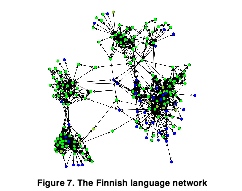
Figure 7

The Finnish network in Figure 7 is qualitatively different. It continues the trend observed in the Portuguese network in that it is smaller and looser, but unlike the previous networks, it lacks an apparent center. Rather, each seed journal and its friends constitutes an independent cluster. Moreover, rather than appearing mainly on the margins of the network, English appears in the centers of the clusters, and even in positions bi-directionally bridging between Finnish journals. This pattern is suggestive of a high degree of Finnish-English bilingualism among Finnish Live-Journalers; indeed, most of the English journals in this network appear to be written by Finns. Thus Finns have conversations on LJ in both Finnish and English, but mostly among themselves. [emphasis mine]

It was in that Thessaloniki hostel lobby that I came to a banal-but-then-amazing realization – while watching a Swedish gent chat up a Japanese lass, I consciously realized, perhaps for the first time, that every day there are probably somewhere in the dozens to hundreds of millions of people speaking to each other in English, for whom English is not a first language. And in the years since (that was in 2002), English has since become not only the default international lingua franca (ironically, mostly not in the Western Hemisphere, where Spanish is increasingly dominant as an international language due to its increased penetration Stateside) but basically the default language of business in the EU. Not due to British cultural imperialism, either – just because it’s easier.

Indeed, English instruction starts so early in most Northern European countries that it can hardly be said to be a non-native language. Especially or the Finns and the Swedes, their export-and-knowledge-based economies (Nokia based in Finland, Linux born in Sweden) demand fluency not just in multiple languages but specifically the international language – and language of the Western internet – English [the Sino-Nipponese-Korean corner of the Net is another story entirely].

I often think about what impacts this will have long-term on the English language – the many divergent strands of slang and local dialect that are emerging among non-native English speakers even as American, Canadian and British regionalisms and colloquialisms are drowned in the ongoing homogenization of our national cultures.

Will an international English-language culture emerge? Has it already – is in fact the (Western) Internet just that? Is the emergence of a more-or-less global language a consequence of transnational trade harmonization – an outfall of GATT, NAFTA, EU, etc. – or does it set the stage for them? Or am I just part of an informational elite that makes it seem like there’s increasing internationalization when for most people, there’s not, and English is just the latest in a series of lingua francas for the transnational global elite? I’m not rightly sure, about any of these things. But it’s something, ain’t it?

Read Full Post »

The Stories We Tell

In my ongoing studies of identity, a thread that comes up again and again is the importance of narrative in determining who we say we are. Demographic groupings are useful for looking at differentials within a society, but showing that Jews disproportionately vote Democratic – even and especially after controlling for income – only really means anything when it’s part of a larger narrative. When you tell the story of why, demography can move from being a series of spreadsheet headings and start becoming a many-layered text.

And just as you can only divide any group – even one so large as a nation – into so many groups before the labels become arbitrary and devoid of explanatory power, so too are there a finite number of stories. Perhaps this is especially so in a nation as large and otherwise diverse as our own; with so many different places and people, what is the one thing we can all point to together? Stories. Apart from Election Day, the largest shared experiences in our country today center around stories – movies and television, millions of people watching and recognizing in themselves the same stories; our sports, the same familiar narratives played out again and again over the courses of games, seasons, careers.

I like talking about the traditional identity markers of Blood, Soil and Church. Viewed in this context, these markers are powerful because of the stories they tell – or rather, the narratives to which they allow us to attach ourselves. One of the reasons that for many these markers are less salient is that for many people, the stories of their Blood, Soil and/or Church are unknown or not relevant to their lives as experienced day to day. Perhaps societal atomization – Putnam’s famous and (rightly) much-maligned “Bowling Alone” – is at least as much the fault of institutions for failing to realize a lack of connection in their ongoing narratives to today’s culture, as it is in individuals for dropping those stories that don’t speak to them.

But unlike voluntary associations, politics is interested in us even if we’re not interested in it, and continues to both bind us together (and divide us) with its narratives, regardless of other societal changes. With that in mind, Robert Reich’s essay on “The Four Stories of American Life” is especially perceptive. The essay is worth a full read – sit down with your favorite beverage at the ready, and take it down in a go – but more briefly, Reich’s four stories are:

1. The Triumphant Individual

2. The Benevolent Community

3. The Mob at the Gates

4. The Rot at the Top

He lays out how each political party and polarity has harnessed – or had harnessed against them – these narratives through our political history, and closes by saying,

“The challenge for Democrats and progressives is not simply to manufacture a new set of stories but to find and tell stories that match their convictions… As the contest unfolds between Obama and McCain, listen carefully for their stories of hope and fear.”

It’s hard not to recast every campaign narrative along these perhaps reductive terms. But I don’t think they’re reductive – rather, they’re our best way of talking to each other across the divides of class, race, geography and language. What is a President, in the end, but a grand National Storyteller – telling the story of – and at their best, making possible – the kind country not only that we live in but that we want to live in.

It’s a time of transition (haha, ain’t it always?), and while I believe that large societal trends have a way of cementing themselves one way or another, I’m no historical determinist. There are moments in the procession of history with many possible Nexts – William Gibson’s “nodal points” – and where the color and shape of what comes after is affected very directly by a limited set of decisions in the Now. Our emerging Now may determine what those next set of markers of identity are – and we’ll see them emerge from what we want the next versions of our national story to be.

Read Full Post »

One of my favorite phrases! And danah’s taken it up,  which gets me to thinking: architecture isn’t deterministic of behavior, but it does create the context in which behavior occurs. If everyone could look in their neighbors’ windows without fear of being seen, a lot more people would do so than currently do. People don’t look in their neighbors’ windows because they’re afraid of getting caught – by those neighbors upon whom they’d be spying, but also by their other neighbors or passers-by, who can see them spying. The latter might even be worse, but fundamentally it’s all about the wonderful social power of shame.

On the Internet, of course, not only does nobody know you’re a dog, nobody knows if you’re a voyeuristic dog – not the object of your observation or the rest of your online village. And I’m not saying that they *should* – but I think it’s worth being conscious of the effects that architecture has on humans. If we can’t introduce shame through fear of exposure of voyeurism – which in the end is just a societal convention – something else will take its place, some other way to flip the finger at the creep staring through your living room window.

I certainly don’t think that people are going to decide to not have fun, or teenagers acquire the judgment (that they’re, y’know, mostly biologically incapable of exercising) or perspective to not act in ways that someone, somewhere might find inappropriate. So what will happen – slowly, as most broad social changes do, but inexorably – is that what’s “embarrassing” will shift. If there are drunken photos of, I dunno, 160 million Americans out on the Internet, that’s hardly something that a future employer can get into a huff about. Especially if there’s one of… them.

But this is a small point – more important is a broad shift in the kinds of information and cues that are and will be instantly (or nearly) available about anyone that we know or meet. We’re curious, so we’ll probably look, but knowing the foibles (or secretly interesting facets) of everyone we care to won’t, in the end, drive us to become vastly more paranoid or secretive. We’re going to have to become more tolerant of all manner of difference because we won’t be able to turn away from it or ignore it. We’ll just have to live with the fact that people are all strange, interesting little creatures, and try to figure out how to get along with each other.

Read Full Post »

Questions of Lifestreaming

Warren Ellis has some thoughts on lifestreaming, via coffee and jerky; I deal with the foodie bits over here. Mostly, he frames it as a series of questions about the efficacy of lifestreaming; the key ones are:

Right now, I’m eating jerky and drinking a cup of coffee. Neither of these came from objects with a net presence, of course. I have to photograph them, curse the really fucking cranky camera in my phone, and upload them. What’s the information? What is the context?…

How much use is this information without personal context? What do you come away with? What have you learned about my life from this instance of lifeblogging, and would you gain a more informed context from a continuous lifestream?…

But what good is a lifestream that communicates nothing about what something means?…

Using the internet to push around basic information in new ways is fun. But it has no meaning without a human context. It’s just lists and bad photographs. That’s not a life….

Have you learned anything useful from what I’m consuming?

I’m not sure that I agree entirely. A blog is a kind of liefestream, albeit with a lot of missing cues, but that’s half the fun, isn’t it? With any kind of writing, and with any writer worth their salt it’s as much a question of what’s left out – and left for the reader to fill in – as what’s written. Lifestreaming, if it’s understood as an attempt to catalog every single thing that happens in a day and put it in some kind of infinitely-faceted context, is no more interesting than reading someone’s diary of every single thing they do in a day. Perhaps good for a lark – and a giving of thanks that you’re not yourself trapped by such a compulsion – but nothing of particular merit or worthy of striving for as a goal. Just because technology will allow us to not only log every conversation and track every receipt in full streaming video doesn’t mean that it’ll be interesting.

But: as our personal technologies capture more and more of the various bands and aspects world around us, more and more continuously and with more and more (often automatically recorded) context, what lifestreaming as opportunity space offers will be increasingly exciting. You wouldn’t want to post the entirety of your walk around the block – with video, audio, GPS coordinates, barometric pressure, etc. – as a lifestream entry. But maybe there was a moment when you looked up and to the left, and the sun glinted just so through the tops of the trees tipped with last night’s frost, and a hawk soared past. Maybe that would be worth both remembering and transmitting to the world (or your little slice of the Intarwub), with or without fuller context.

That doesn’t quite answer Ellis’ central question:

Have you learned anything useful from what I’m consuming?

Well, sure. Do I know what it tastes like, what it was like to be Warren Ellis eating that jerky, drinking that coffee? No. But for me: I don’t care. Indeed, it goes beyond not caring – I find most of human experience entirely ineffable, mine included. I enjoy talking to people, hearing them describe what life is like for them, but long ago came to the conclusion that that I was an unreliable enough narrator of my own experience, and could not really hope to understand what it was like to be them or to experience things as they did.

So what does it mean? No matter how much or how little metadata’s attached, it still only means something to me as a function of my own (imperfectly understood) experience.

Read Full Post »

« Newer Posts